
Aqua Coat Water Based Finishes

Our Guarantee

Testimonials

Love the paint that we bought, it flowed so nice and covered very well. The price for what we got truly was a great deal.

Bob


I have been a general contractor since 1988 and build only the finest of custom homes. I prefer and recommend Aqua Coat for any of your painting and fine finishing needs... Aqua Coat does exactly what they say they will do and nothing less.

Dave
Dave's painting


Different Types of Wood.

  • Pine                                                               
  • Oak
  • Walnut
  • Mahogony
  • Hard Maple
  • Cherry
  • Ash, Elm, and Chestnut
  • Aromatic Red Cedar
  • Soft Maple and Poplar
  • Birch
  • Oily Woods


Woods vary in color, density, and texture. One must consider the Characteristics of a

specific species of wood before deciding how to finish it. Next we will discuss in detail the

different type wood species and some tips on how to finish these types of wood.

Water-based Finishes.

Water-based also known as waterborne is made with acrylic and polyurethane resins

that are dispersed in water. To make water based finishes, the acrylic and polyurethane

resins are manufactured in tiny little droplets that are dispersed in the water. After the

water evaporates , the tiny droplets of finish come together and harden creating a

continuous film. Once cured, water has no damaging effect on water-based finishes. 


Some water-based finishes are provided with a separate “cross-linker” or “hardener”

that you can add to the finish to make it more protective and durable. These 2-part

finishes are available at Aqua Coat. Our AquaThane clear finish and our cross-linker

will give you a surface as tuff as nails. Other water-based finishes have a built-in

cross-linker. Such as Aqua Coat’s commercial Table-top finish with a pre-cat already 

built in.

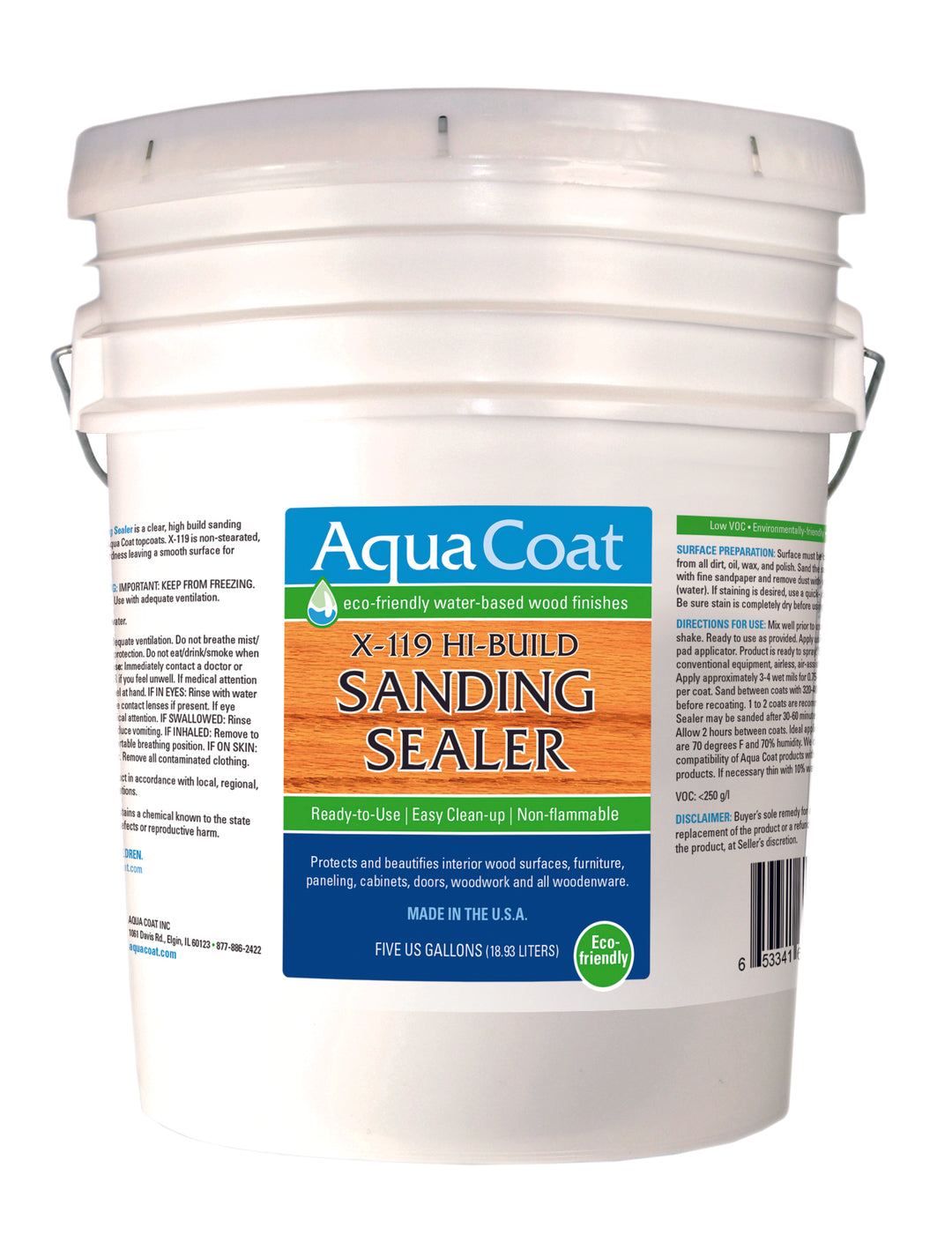
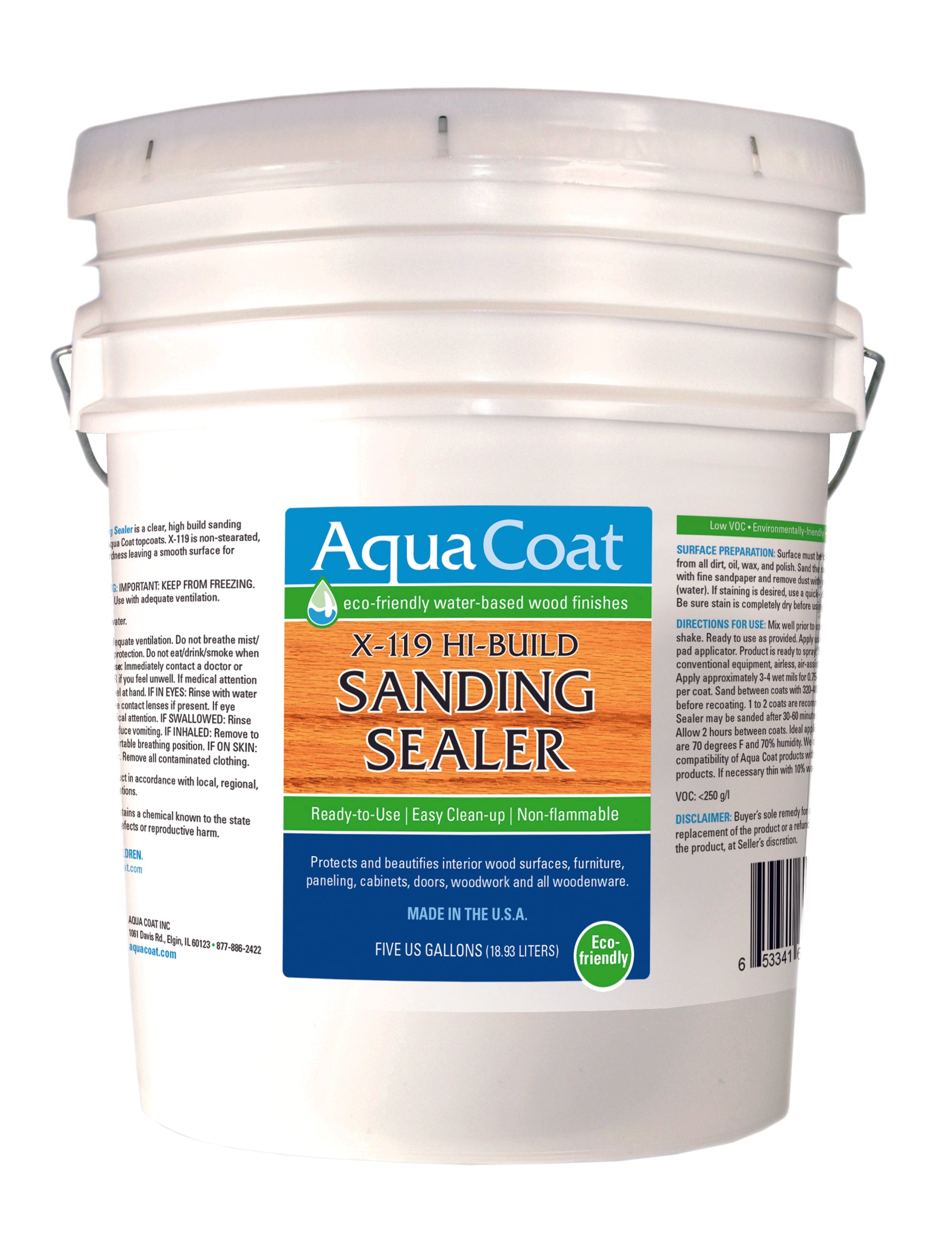
Why use Sanding Sealer?

Applying sanding sealer is a vital step needed in finishing high quality furniture and trim.

Sanding sealer is used as an added layer of protection for the wood and to create a nice

smooth finish. It can be used on stained or unstained wood. Staining or leaving the wood

natural is your first step in finishing. The second step of the 3 step process would be to

use a sanding sealer to create a stronger, longer lasting finish. Aqua Coat  x119 sanding

sealer is perfect for the job.  Using the X119 sanding sealer  makes a heavily grained wood

smooth to the touch. Using 2 coats of sanding sealer will create an even smoother finish.

Sanding sealers fill and raise the wood grain, creating a rough, gritty feel. After the wood

is sanded with a fine grit sand paper, it is ready for the 3rd and final step which would be

a clear non-yellowing topcoat which you can find in Aqua Coat’s full top coat line.

Why Finish Wood Anyway?

  • Sanitation

Wood is a porous material. It contains countless holes of various sizes. These holes

can collect dirt and grime from handling, atmospheric, contaminants, and food.

Grime in the wood pores is unattractive, and it can be a health hazard providing a

breeding ground for bacteria. A finish seals a porous surfaces to help prevent soiling

and easier to clean.


  • Stabilization

Wood is not only porous it ‘s hygroscopic. It absorbs and releases moisture. Wood

responds to changes in the level of moisture around it. The moisture is absorbed by

the wood as the wood then swells. The opposite occurs when you put wood in a

dry climate – it shrinks. The surface of wood, for instance responds more readily

than the core. Wood mainly swells and shrinks across the grain. This causes

stresses in wood. Stresses cause splitting, checking, and warping.


  • Decoration

You can decorate wood with color, texture, and sheen.


Controlling Sheen with Flatting Agent

Flatting agent is the solid stuff, usually silica, that settles to the bottom of the container 

of satin or flat finish. When stirred into the finish and applied to wood, the flatting agent

reduces the gloss by creating a micro-roughness on the surface. The more flatting agent 

added to the finish (top coat) the lower the sheen.

All film finishes including Aqua Coat top coats and excluding shellac, are available with

flatting agent included. The finishes can be labeled; rubbed effect, low sheen, satin,

semi-gloss, gloss.


Aqua Coat has a flatting agent that  is available to use with our clear finish

topcoats to create your own sheen by adding it to the finish.


It’s the topcoat that creates the sheen. Coats underneath have very little or no impact. 

Because the flatted effect is created by a roughened surface and not by the particles that

have cured deep within the film, it should be obvious that the last coat of finish applied

establishes the sheen. Many flatted finishes appear to scratch more easily than gloss

finishes.


What causes blotching ?

Blotching is caused by stain penetrating deeper into some parts of wood than in others.

It’s common with woods that have uneven densities.  Examples in soft wood;

pine and fir. Tight grain hardwoods such as cherry, birch, maple, poplar, aspen, and

alder. At last there may be a solution!!  A product available soon at Aqua Coat.

Spray Gun Categories.

Conventional Spray Guns –

 The traditional high pressure guns powered by compressed air (commonly 35 to 45 psi)

These guns have been in use the last century.


Turbine HVLP (high volume low pressure)-

Technology that was introduced in the 1950′s but it didn’t receive wide acceptance until

the 80′s when tougher environmental laws made it make sense. A Turbine HVLP uses a

high volume of air supplied by a turbine blower instead of compressed air to atomize liquids.

By reducing the pressure creates a soft spray with much less bounce back and waste that

occurs with high pressure conventional spray guns. Turbines with more fans, or stages,

supply higher volume and pressure.


Compessor HVLP -

Technology introduced in the late 1980′s in which compressed air is converted in the body

of the gun to high volume and low pressure. It too produces a soft spray with very little

bounce back and waste. HVLP spray guns have a higher transfer efficiency than conventional

spray guns. Due to it’s soft spray velocity about two-thirds of the liquid material is deposited

on the sprayed surface, as where conventional spray guns deposit only about a third.


Airless (hydraulic – atomization) -

Spray guns are powered by a pump that pushes liquid material through a very small

spray-nozzle orifice at up to 3000psi. A very large volume of liquid material can be sprayed

with airless systems. The atomization is not as fine as with other systems that’s why

orange peel can be pronounced with this system. Airless spray guns aren’t often used to

spray clear finishes onto fine wood.


Air-assisted airless and air mix-

Are powered by both medium -pressure (800 to 1000psi) pump and compressed air. About

80% of the spray pattern is achieved through hydraulic atomization while 20% through

the impingement of low pressure air.


Finishing Spray Gun Equipment.


A spray gun can turn a stain or top coat into a fine mist –a processed called atomization

which propels the mist onto a work surface. Compared to rags and brushes, spray guns

transfer liquids faster and leave a more level surface. Air from a compressor or turbine

enters the gun through the air inlet  at the bottom of the handle. When you pull the trigger

just a little, the air valve inside the handle opens and allows air to flow through the gun.

Pulling the trigger farther retracts the fluid needle, which allows liquid material to stream

out the fluid nozzle. The result is an atomized fluid  stream in a shape varying from a

circular to oval fan shape pattern. Coming soon; different categories of  spray guns for

wood finishing.

Advantages with water-based finishes

Fast building.

The key to any finish is the resin, or solid, that dries to form the final film. The higher the

solids a finish contains, the thicker the dry film will be. A typical water-based finish derives

about 35% – up to as high as 50% of it’s weight from solids, whereas most traditional lacquers

have a solid content of 20%-25% or in some cases even lower. The higher solid count in

water-based products help the finish build faster, requiring fewer coats.


Nonflammable. 

Water based products carry less dangerous material such as high amounts of solvents. It’s

solvents that make the products flammable. Water-based stain and topcoats are more

friendly to you as a user, and to the environment.


Fast drying.

It’s fast drying compared to brushable varnishes and polyureyhanes. The drying times for

water-based finishes can’t be beat. Fast drying properties of water-based stains and top-coats

give them definite advantages compared to solvent based products, especially when applying

them by brush. They dry so quickly that dust settling in the wet finish is significantly reduced.

If you wanted to slow down the dry time you can use some retarder to accomplish that.


Clear drying and non-yellowing.

The exceptional clarity of most water-based products make them the ideal choice when

you want the wood but not change it’s color. Water-based finishes won’t yellow with age

the way most lacquers and varnishes do.


Durable and scratch resistant.

Resins used in water-based finishes have improved to the point where most products are

durable, if not more so, then solvent-based materials. Aqua Coat has a commercial tabletop

finish that is as tough as nails. This water based table top finish forms a tough flexible film

that is highly scratch resistant, and can withstand most forms of abuse.


What is Wiping Stain?

Wiping Stain is very similar to gel stains as far as being heavy bodied stain that doesn’t

need to penetrate into the wood in order to tone the wood to the desired shade. The wiping

stain is more resistant to blotching than penetrating stains due to the fact it doesn’t deeply

penetrate the wood. Also, you can use wiping stain over previously finished wood to

change the wood tone color without stripping the old finish off.  The largest advantage to

wiping stains is it allows for a lot more control over the stain color.